Deadly Conduct Discharge of Firearm Defense

1 / 5


Deadly Conduct Discharge of Firearm Defense
Starting at $7,500
Hourly beyond scoped fee: $250
Free 30-minute consultation
Schedule Your Free Consultation
Felony deadly conduct, under Texas Penal Code Section 22.05(b), covers knowingly discharging a firearm at or in the direction of one or more people, or at or in the direction of a habitation, building, or vehicle the actor is reckless about being occupied.1 It is a third-degree felony, carrying a prison range of two to ten years and a fine of up to $10,000.2 No one needs to be hit for the State to bring the charge. Forrest Good PLLC represents people charged with felony deadly conduct from the Bexar County grand jury stage through final disposition in a criminal district court.
What a felony deadly conduct charge is
The felony grade of deadly conduct is defined by Texas Penal Code Section 22.05(b), and it has two distinct clauses.1 Subsection (b)(1) reaches a knowing discharge of a firearm at or in the direction of one or more individuals. Subsection (b)(2) reaches a knowing discharge at or in the direction of a habitation, building, or vehicle when the actor is reckless about whether it is occupied.1 Neither clause requires that anyone be struck. The conduct is the discharge in the prohibited direction, not the result.
As a third-degree felony, the charge carries two to ten years in prison and a fine of up to $10,000.2 The two clauses cover meaningfully different conduct, and the State has to prove the elements of whichever clause it charged: the knowing-discharge-toward-a-person element under (b)(1), or the discharge-toward-a-structure plus reckless-as-to-occupancy element under (b)(2). That structure is where most felony deadly conduct cases are won or lost.
The forms a felony deadly conduct charge can take
Section 22.05(b) is charged on very different fact patterns. These are the variants a felony case most often turns on.
Discharge in the direction of a person
Under subsection (b)(1), a knowing discharge of a firearm at or in the direction of one or more individuals is the offense, whether or not anyone is hit.1 The contest is usually whether the discharge was actually in the direction of a person, as the statute defines that phrase, or whether it was a discharge into the air that the State has reframed as directed.
Discharge toward an occupied structure or vehicle
Under subsection (b)(2), a knowing discharge at or in the direction of a habitation, building, or vehicle, where the actor is reckless about whether it is occupied, is the offense.1 Here the occupancy element and the recklessness-as-to-occupancy element are both contestable: whether the structure was occupied, and whether the actor was actually reckless about that.
Celebratory firing reframed as deadly conduct
A recurring Bexar County fact pattern is celebratory firing on New Year's Eve or the Fourth of July, where shots fired into the air are charged under (b)(1) as a discharge in the direction of people. Whether a vertical or near-vertical discharge meets the statute's directionality requirement is frequently the central question in those cases.
Who a felony deadly conduct charge reaches
Felony deadly conduct reaches people who never intended to hurt anyone and people no one was hurt by. Someone who fired a gun in celebration, someone who fired a warning shot in a confrontation, and someone who discharged a firearm near an occupied structure can all face a third-degree felony, because the statute is built on the act of the directed discharge rather than on any injury.
A felony conviction carries weight a misdemeanor does not. It triggers the Texas firearm prohibition under Section 46.04 and the federal felon-in-possession prohibition under 18 U.S.C. Section 922(g)(1),34 mandatory DNA collection,5 potential immigration consequences, and a permanent felony record that reaches voting, employment, and professional licensing. That collateral weight is why a felony deadly conduct charge has to be contested from the grand jury stage forward.
What is actually at stake
The criminal exposure on a third-degree felony is two to ten years in prison and a fine of up to $10,000.2 A felony conviction also strips the right to possess a firearm under both Texas law, Section 46.04, and federal law, 18 U.S.C. Section 922(g)(1),34 and it triggers mandatory DNA collection.5 The record is permanent and reaches far past the sentence itself.
Because the directionality and occupancy elements are demanding, a felony deadly conduct case is one where the grand jury stage matters. A persuasive grand jury packet that shows the discharge did not meet the statute's directionality requirement, or that the structure was plainly unoccupied and known to be so, can produce a no-bill before an indictment ever issues. Whether a no-bill, a reduction, a dismissal, or a trial is realistic is a fact-specific question decided from the scene reconstruction and the ballistics record, not promised in advance.
What to know if you have been charged
A felony deadly conduct case is built from the scene, the trajectory of the rounds, any recovered shell casings, the ballistics record, and the witness accounts of where the firearm was pointed. What a person does in the first days affects all of it. The most common mistake is explaining the discharge to officers at the scene; statements are recorded and used, and an account meant to give context often supplies the knowing-discharge or reckless-as-to-occupancy element the State has to prove.
A few steps help in nearly every case. Write down what happened while it is fresh, including where the firearm was actually pointed and where any people or structures were. Preserve the firearm and any ammunition exactly as they are, and do not handle or move shell casings. Identify any business, doorbell, dash, or phone video, since that footage often shows the actual direction of the discharge that the case turns on, and it is overwritten if no one asks for it. Keep all paperwork from the arrest, and do not contact any complainant. If self-defense or defense of another is in play, the justification defenses in Chapter 9 are evaluated from exactly these facts.6
This is general information about how these cases work in Texas. It is not legal advice about any specific case, and reading it does not create an attorney-client relationship.
How a felony deadly conduct case moves through the courts
A third-degree felony in Bexar County follows the felony path, which adds a grand jury step the misdemeanor process does not have. Knowing the order of events makes the process less frightening and the decision points easier to see.
Arrest and magistration
The case ordinarily begins with an arrest. The person is brought before a magistrate, who gives the statutory warnings and sets bond.7
Grand jury review
A felony charge has to be presented to a Bexar County grand jury, which decides whether to return an indictment or a no-bill.8 The grand jury stage is the first real opportunity to show that the discharge did not meet the directionality or occupancy elements, and a defense packet at this stage can change the outcome before an indictment issues.
Filing in a criminal district court
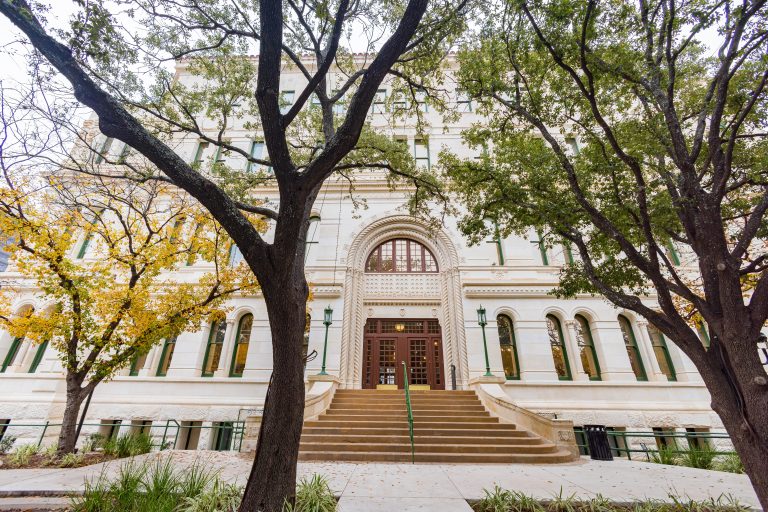
On indictment, the case proceeds in one of the Bexar County criminal district courts, designated by the Government Code,9 at the Cadena-Reeves Justice Center on Dolorosa Street.10
Pretrial settings and resolution
The case moves through pretrial settings, with the State's evidence produced under the discovery statute, Article 39.14.11 It can resolve by no-bill, dismissal, reduction, negotiated plea, or trial, and the realistic routes depend on the scene reconstruction, the ballistics, and the record.
The deadlines that matter
A felony deadly conduct case does not carry the fast administrative clock a DWI does, but timing still decides what evidence survives and what options remain, and the grand jury window is the one that closes first.
- Before the grand jury convenes to prepare and present a defense packet, because the no-bill opportunity exists only before an indictment is returned.
- As early as possible to preserve the body-worn camera from every responding unit, the dispatch and CAD records, and any business, doorbell, dash, or phone video, which is subject to a retention schedule and is routinely overwritten if it is not requested in time.
- Promptly to preserve and document the firearm, the ammunition, and the scene, including any recovered shell casings, before the physical evidence degrades or is released.
- Throughout the case, the State carries a continuing duty to disclose evidence under Article 39.14; that duty is enforced by motion, not assumed.11
- Within the limitations period for a felony, the window in which the State must obtain an indictment.12
How Forrest Good PLLC approaches a felony deadly conduct charge
Forrest Good PLLC reads a felony deadly conduct file against the three elements the State has to prove: directionality, occupancy where a structure or vehicle is alleged, and the recklessness-as-to-occupancy state.1 The questions the file has to answer: Was the discharge actually in the direction of a person or structure as the statute defines that phrase, or was it celebratory firing into the air that the State has reframed. Does the scene reconstruction support a trajectory consistent with the alleged direction. Where the State alleges a discharge toward a vehicle or habitation, was the actor actually reckless about occupancy under Section 6.03(c), or was the structure plainly unoccupied and known to be so.13 What does the ballistics record actually show about the firearm of origin and the recovered casings.
The State's evidence is requested through formal discovery under Article 39.14, including the offense report, the dispatch records, the scene photographs, and the ballistics protocols.11 Forrest Good PLLC frequently retains an investigator to canvass the scene and to interview witnesses the responding officer never reached, and frequently subpoenas the agency's ballistics protocols where the State's identification of the source firearm is contested. Where the facts support it, self-defense and defense of a third person under Chapter 9 are developed from the same record.6 Because the grand jury stage is decisive on this charge, a no-bill strategy is evaluated at the outset, and whether to pursue a no-bill, a reduction, a dismissal, or a trial setting is decided with the client.
How time and fees work
The hour estimate
Forrest Good PLLC estimates this matter at 30 to 50 hours of attorney time, billed at $250 per hour. The lower end reflects a case that resolves on a grand jury no-bill or an early plea; the upper end reflects contested trajectory or ballistics litigation, full scene investigation and investigator field work, and a trial-ready posture. The pricing methodology explains how the charging instrument, the evidence load, and the procedural stakes drive the estimate.
The flat fee and what it covers
The starting flat fee is $7,500. It covers grand jury packet preparation and presentation strategy; scene investigation, review of ballistics records and any recovered shell casing inventory, and trajectory analysis where appropriate; review of the offense report and every body-worn camera and in-car video, the dispatch and CAD records, and the scene photographs; witness interviews; written motion practice, including motions to suppress, motions for production under Article 39.14, and motions in limine;11 self-defense and defense-of-third-party analysis under Chapter 9;6 and full plea negotiation and every pretrial setting in a Bexar County criminal district court. The fee shown here is honored while this page is published, consistent with Texas Disciplinary Rule of Professional Conduct 7.02(d).14
What is billed separately
- Court costs and fines imposed at sentencing
- Expert witness fees, such as a ballistics, trajectory, or medical-forensic expert
- Any anger-management or coursework costs ordered by the court
- A jury trial setting, priced separately starting at $25,000 for a felony
- An appeal to the Court of Appeals, quoted separately based on the length of the record
Any work outside the scoped fee is billed at $250 per hour and is disclosed in the written engagement letter before it begins. The engagement letter is the binding contract for the matter.
Starting with a free consultation
The first step is a conversation. The initial 30-minute consultation with Forrest Good PLLC is free and is scheduled through the office's Google Booking page. It is the time to walk through the scene, the trajectory, and the ballistics, and to test the directionality and occupancy elements before the grand jury stage. Bringing the bond paperwork and a list of any bystander or phone video makes the half hour far more useful.
No attorney-client relationship is formed until a written engagement letter is signed; the consultation itself carries no obligation.
Sources
- 1. Tex. Penal Code § 22.05(b) (West 2025).
- 2. Tex. Penal Code § 12.34 (West 2025) (third-degree felony penalty range).
- 3. Tex. Penal Code § 46.04 (West 2025) (unlawful possession of firearm).
- 4. 18 U.S.C. § 922(g)(1) (2018) (felon-in-possession prohibition).
- 5. Tex. Gov't Code § 411.1471 (West 2025) (mandatory DNA collection on felony arrest/conviction).
- 6. Tex. Penal Code ch. 9 (West 2025) (justification defenses, §§ 9.31, 9.32, 9.33).
- 7. Tex. Code Crim. Proc. art. 15.17 (West 2025) (duties of arresting officer and magistrate; bond at first appearance).
- 8. Tex. Code Crim. Proc. ch. 19A (West 2025) (grand jury organization and proceedings).
- 9. Tex. Gov't Code §§ 24.246, 24.276, 24.294, 24.295, 24.349, 24.444, 24.532 (West 2025) (Bexar County criminal district court designations).
- 10. Cadena-Reeves Justice Center, 300 Dolorosa St., San Antonio, TX 78205.
- 11. Tex. Code Crim. Proc. art. 39.14 (West 2025) (Michael Morton Act).
- 12. Tex. Code Crim. Proc. art. 12.01 (West 2025) (limitations periods for felonies).
- 13. Tex. Penal Code § 6.03(c) (West 2025) (definition of recklessness).
- 14. Tex. Disciplinary Rules Prof'l Conduct R. 7.02(d) (Tex. Sup. Ct.).
Pricing current as of May 2026. Forrest Good PLLC honors the starting fees shown on this page while they are published. The initial 30-minute consultation is complimentary. No attorney-client relationship is formed until a written engagement letter signed by Forrest Good PLLC and the client is in place.